
Moxi the hospital robot gives nurses time back
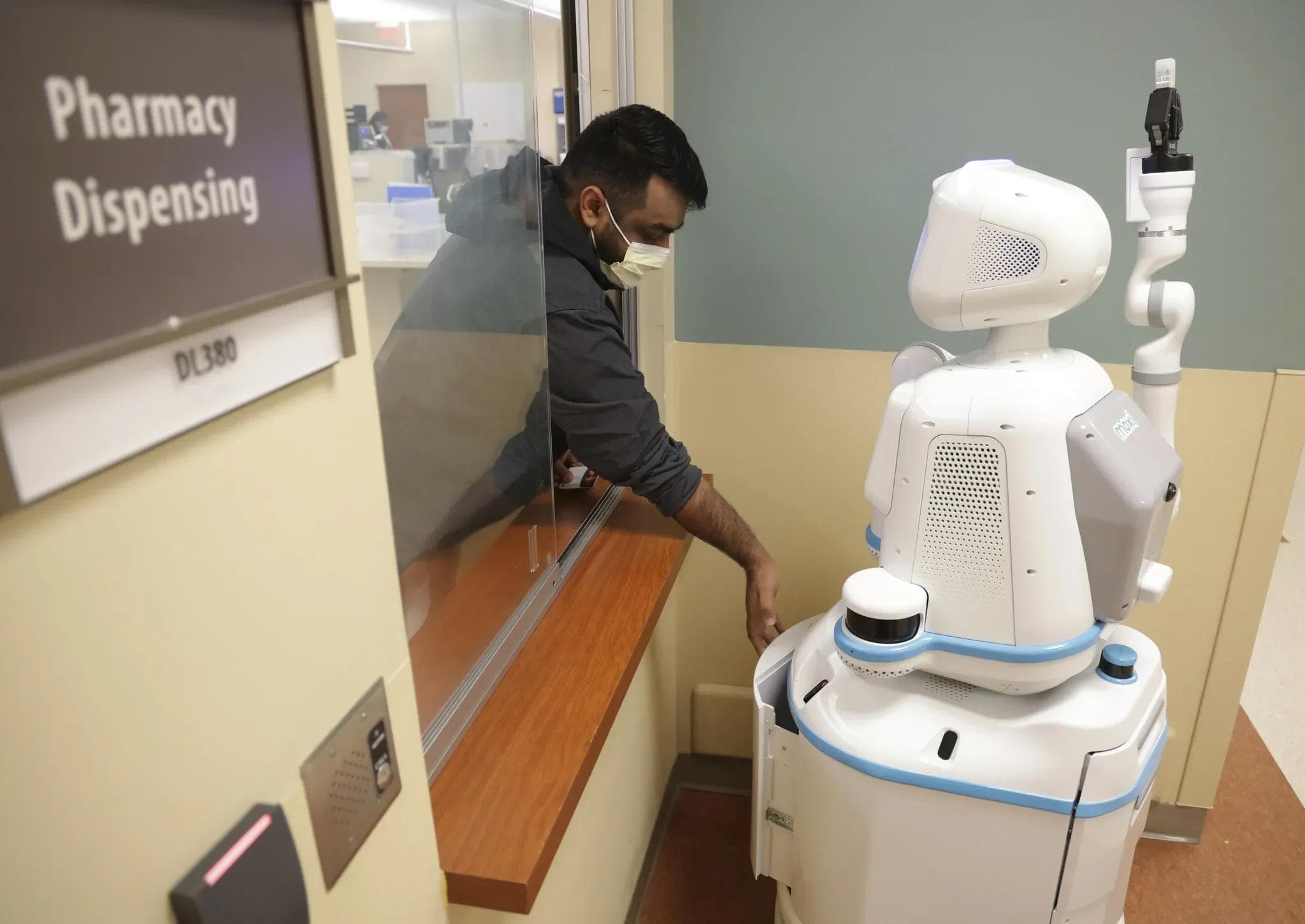
At Mary Washington Hospital, WIRED found a cleaner robotics story than spectacle: a mobile assistant taking routine delivery runs so nurses can stay closer to patients.
What this story shows
- Moxi is a service robot, not a clinical replacement: it handles routine delivery and handoff work around the hospital.
- The human value is concrete: fewer supply runs for nurses and more time near patients.
- Healthcare buyers should start with repetitive, non-patient-facing workflows before asking robots to touch clinical judgement.
The most persuasive healthcare robot story is not a machine making medical decisions. It is a robot taking one more trip down the hall so a nurse does not have to.
WIRED's reporting from Mary Washington Hospital in Fredericksburg, Virginia, follows Moxi, Diligent Robotics' wheeled hospital assistant. The robot moves through hospital corridors carrying items such as supplies, lab samples, medications, and personal belongings. Its job is not to provide care. Its job is to take routine delivery work away from clinical staff so people can focus on care.
What Moxi actually does
Diligent describes Moxi as a robot for non-patient-facing tasks: running patient supplies, delivering lab samples, fetching central supply items, distributing PPE, and delivering medications. The robot is built for the semi-structured reality of hospitals: corridors, elevators, nursing stations, changing priorities, and people moving around it.
WIRED notes that nurses could send Moxi tasks from kiosks at nursing stations or by text message. That matters because adoption is not only a hardware question. A useful hospital robot has to fit the handoff pattern of the staff already doing the work.
The human result
At Mary Washington, two Moxi robots had been operating since February 2022 when WIRED reported that they had given workers back about 600 hours. The article also cites an American Nurses Association-supported case study of Moxi trials in Texas, where a majority of 21 interviewed nurses said the robot gave them more time to talk with patients being discharged.
That is a much stronger story than a vague promise about automation. The patient does not need a robot nurse. The patient needs the human nurse to have fewer low-value errands pulling them away from the bedside.
- The robot handles repeated transport and handoff tasks around the hospital.
- Nurses remain the clinical experts, decision-makers, and human presence at the bedside.
- The hospital still has to manage supply accuracy, privacy, cybersecurity, congestion, and exceptions.
“The stronger story is not a robot at the bedside. It is a robot that helps keep trained humans at the bedside.”
Why buyers should care
The adoption signal has only become clearer. In 2025, Business Insider reported that Moxi robots had made more than 1.2 million supply deliveries across 25-plus hospitals, with Diligent estimating about half a million hours of human time saved. Those numbers are useful because they keep the story measurable: trips removed, time returned, people supported.
For marketplace buyers comparing hospital delivery robots, Moxi is a practical filter. Do not start by asking whether the robot looks human. Start by asking what task it removes, whose time it gives back, what system it integrates with, and whether staff can trust it enough to treat it as part of the team.
More stories
View all
Robs are great
Lorem ipsum dolor sit amet, consectetur
Robots are the future
Robots are the absolute future we have.

In Salinas Valley, a lettuce robot turns hard field work into teamwork
WIRED's field report from California shows a simple but powerful robotics story: workers and machines sharing the harvest instead of standing on opposite sides of it.